The main details
Designing of multifunctional smart porous carbon textiles decorated with novel MOF nanocomposites as protective media against toxic vapors
Multifunkcjonalne porowate tkaniny węglowe domieszkowane nanokompozytami MOF jako materiały ochronne przed toksycznymi oparami
Budget: 1,999,580 PLN (~470ooo €)
.
The main Poster – The project at a glance
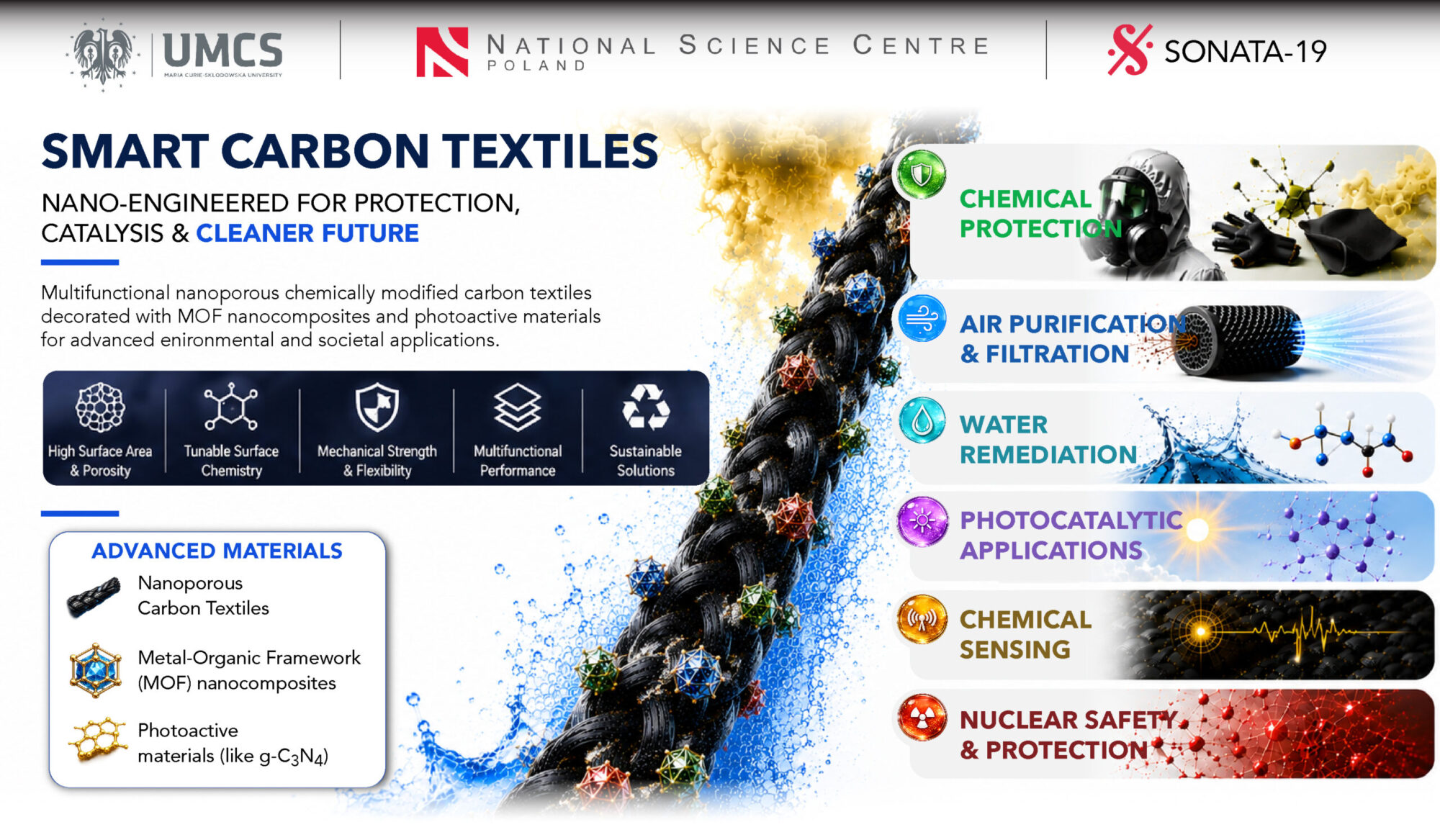
The background and Our general Vision
The main objective: To develop a new generation of multifunctional carbon textiles capable of protecting against toxic airborne contaminants through the integration of adsorption, catalytic detoxification, sensing, and advanced material engineering.
From the past until now, airborne contaminants are a great concern for the public health, due to the upcoming disasters, wars, industrial activities and accidents. Therefore, novel advanced low-cost media, capable to protect against emerging gaseous threats are still on a great demand. The dawn of utilizing chemicals compounds used as weapons known as Chemical Warfare Agents (CWAs) occurred during First World War, and hence, the protection of the soldiers and the staff on the war camps was of a high importance. Even though that face masks able to avoid the inhalation of toxic compounds were efficiently developed, protection media for the entire body were still needed. According to the existing reports, the modern CWAs are various and contain unknown compounds that cannot be blocked by the existing protection media, since physical adsorption is inefficient. Thus, the need for reactive media that not only block but also decompose catalytically the toxic compounds are of a great demand. Apart from the upgrade of protection media for the army, there is a need to have available cheap options for the protection of populations in urgent cases. Recently, this was obvious during the early stage of Covid pandemic, that many countries run off the cheap and easy to make disposable face masks. Similarly, the fear of a potential accident at a nuclear station or a hazardous industry should be overcome by creating effective and cheap “tools”.
Porous carbons were initially used during the First World War to fill the canisters of the face masks and are also used up today intensively for various filtration applications, like gas masks, car cabin filters, AC filters etc. The main challenge is the transition from carbon powders to carbon filters, in order to have an easy use to plenty of applications. During the last years, due to the advancements in nanotechnology, the option to prepare textiles made from nanoporous carbons is provided. Even though these textiles can have elevated removal efficiency against various pollutants, they have some crucial disadvantages. The most important are that their efficiency is based on adsorption phenomena and that if the maximum adsorption capacity will be reached, the textile is not active anymore. For instance, carbon textiles can adsorb only limited amounts of specific toxic vapors, such as the blister agent mustard gas and various nerve agents. Hence, the modification of these textiles with reactive materials capable to multifunctionally purify air streams from toxic compounds by adsorption and (photo)catalysis is crucial, whilst will possess the ability to detect the toxic compounds by change in color or in conductivity.
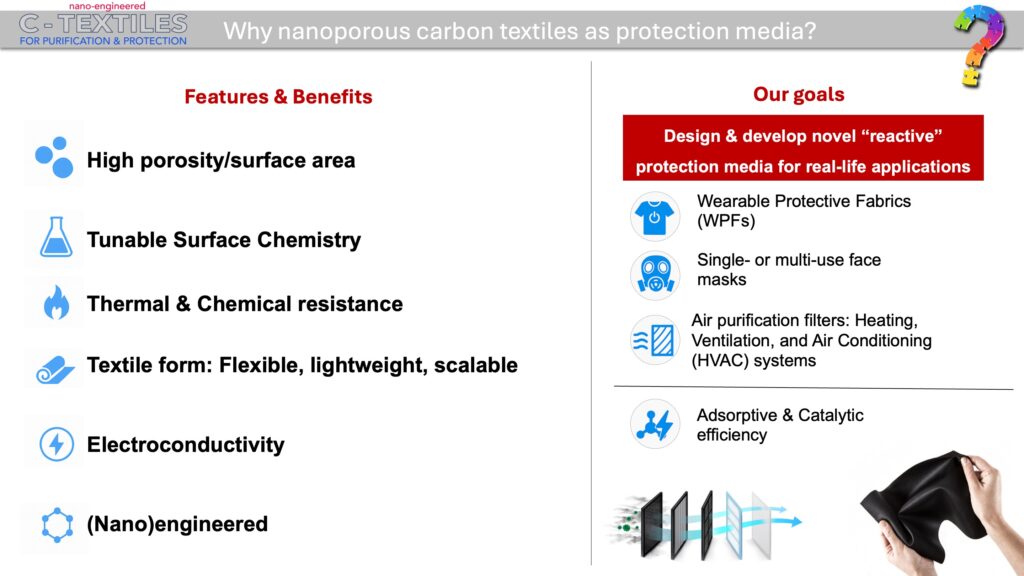
The main goal of this research project is to design and fabricate a new class of advanced nanoengineered multifunctional (nano)porous composite carbon textiles, herein called as smart CCTs, that can be used either as a protective layer of warfighters’ garments, or flexible part of gas masks and other paraphernalia (glows, socks etc.), as well as for easy to use single-use/disposable face masks for public protection against chemical warfare agents (CWAs) and other toxic gaseous pollutants. The target application of CCTs development was chosen due to a paramount civilizational and societal importance – protection from toxic airborne contaminants. Since the fabricated CCTs will be mechanical stable and flexible/elastic, their appliance can be expanded for other scopes like ACs filters, curtains, car cabinet filters, war emergency protection towels and blankets.
In addition to conventional vapor-phase evaluation, the developed composite carbon textiles will be systematically tested against both toxic vapors and liquid droplets of representative hazardous compounds in order to assess their multifunctional protective performance under diverse exposure scenarios. Even more importantly, special emphasis will be placed on aerosol detoxification, as aerosols represent one of the most realistic and challenging routes of contaminant exposure, enabling the investigation of adsorption and catalytic detoxification mechanisms under conditions that closely mimic real-life applications.
Moreover, the obtain knowledge will be applied to create alternative porous carbon bases remediation composite media that can be used against other potential pollutants, like formaldehyde and radioactive sprays. Finally, the photoactive MOF-based composites will be tested as (photo)catalyst for other environmental and sustainable reactions, like biomass valorizations.
The main team

Dimitrios Giannakoudakis
Principal Investigator

Mariusz Barczak
Co-Investigator

Humam Ahmed
Post doctoral researcher

Fivos Florides
PhD candidate
Established collaborations

dr Aldona Nowicka
(UMCS, SEM-EDX expert)

dr Marcin Kuśmierz
(UMCS, XPS expert)

Kyriakos Ioannou
(Erasmus visitor)

Nikolaos Kostoglou
(Institute of GeoEnergy, FORTH Hellas)

Prof. Claus Rebholz
(University of Cyprus)
Prof. Ioannis Paschalidis
(University of Cyprus)

Marlena Bytniewska
(UMCS, PhD candidate)

dr Elena Salonikidou
(AUTH, visiting researcher)

dr. Michael Kallitsakis
(AUTH, Visiting researcher)
The main goals – Abstract
Airborne contaminants were, are, and will be a great concern for the public health, due to the upcoming disasters, wars, industrial activities and accidents. Therefore, novel advanced low-cost media that will be capable to protect against emerging gaseous threats are still on a great demand. The main goal of this research project is to design and fabricate a new class of advanced nanoengineered multifunctional (nano)porous composite carbon textiles, herein called as smart CCTs, that can be used either as a protective layer of warfighters’ garments, or flexible part of gas masks and other paraphernalia (glows, socks etc.), as well as for easy to use single use/disposable face masks for public protection against chemical warfare agents (CWAs) and other toxic gaseous pollutants.
Various carbon textiles with a wide variation of important physicochemical characteristics (pore structure, morphology, surface chemistry) and properties (hydrophilicity, conductivity, stability, catalytic reactivity) will be initially evaluated to determine the optimum textile and the properties that influence the adsorptive capability of apCTs. Since the surface chemical heterogeneity of apCTs is known to have a vital role on the adsorptive efficiency, we will seek to identify the role of different heteroatoms doping (O, N and S). Even more essentially, the presence of surface functional groups is expected to affect positively the nanoparticles (NPs) decoration “quality”, the resulted synergistic effects upon chemical bonds creation, and more importantly the final detoxification efficiency. By tuning apCTs’ surface chemistry, it will be feasible to realize the optimal parameters in order to achieve the desired amount, thickness, and homogeneity of active phase decoration and to conclude regarding the mechanisms of NPs interaction with apCTs surface. Towards enhancing the adsorptive and/or catalytic efficiency, nanocomposites of MOFs with defected nanostructured graphitic carbon nitride will also be developed and utilized.
Analysis of mechanisms involved on the anticipated catalytic decomposition will also be investigated in depth. The target applications were chosen due to their paramount civilizational and societal importance, protection from toxic airborne contaminants. Since the fabricated CCTs will be mechanical stable and flexible/elastic, their appliance can be expanded for other scopes like ACs filters, curtains, war emergency protection towels and blankets. Moreover, the obtain knowledge will be applied for other porous carbon bases remediation media, like car filters, and against other potential pollutants like formaldehyde and radioactive sprays.
The proposed research will target to provide answers to the following research questions:
- How the incorporation of various O, N and S containing surface functional groups (SFGs) will affect the final properties of apCTs including porosity, conductivity, mechanical integrity and how the remediation performance is affected?
- How will the growth/dispersion of nano-sized MOFs depend on the chemical and morphological features of the carbon substrate? Can the size of the nanoparticles and the thickness layer be precisely controlled?
- Can we increase the efficiency of reactive adsorption/(photo)degradation by forming nanocomposites with g-C3N4 or tuning the way of decoration?
- Which are the mechanisms linked to the adsorptive and (photo)catalytic activity? Are the target air-purifying processes based on (photo)chemical degradation or adsorption phenomena?
- How the mechanical integrity and elasticity of the nanocomposite textiles is affected by multicycle use in targeted processes. Can they be potentially used for alternative flirtation media?
Based on all the above approaches, the project will have a highly transformative nature since the collected results can open new unexplored routes for the development of alternative air purification applications for traditional carbon-based materials as well as in catalysis and chemical synthesis like green fuels production by biorefineries. This transformative nature will be enhanced by the approach of the potential use of various potential SBUs and linkers towards MOF or ZIFs and by testing the obtained materials from an existing network of collaborator with experience for instance on radionuclides remediation, (photo)catalytic decomposition of emerging organic pollutants in aqueous matrixes, and (photo)catalytic biomass valorization.