Peer-Reviewed Article #1
Ultrahigh surface area nanoporous carbon for air and water purification: Pushing the boundaries and unveiling the key physicochemical features
Dimitrios A. Giannakoudakis1,2*, Ioannis Ioannidis3,*, Kyriacos Ioannou4, Eleni D. Salonikidou2, Fivos Florides1, Stefan Zeiler5, Nikolaos Kostoglou5,6, Mariusz Barczak1, Konstantinos Triantafyllidis7,8, Ioannis Pashalidis3, Claus G. Rebholz4,*
1 Institute of Chemical Sciences, Faculty of Chemistry, Maria Curie-Sklodowska University, Maria Curie-Sklodowska Sq. 3, 20031 Lublin, Poland
2 Department of Chemistry, Aristotle University of Thessaloniki, University Campus, Thessaloniki, Greece
3 Department of Chemistry, University of Cyprus, P.O. Box 20537, 1678 Nicosia, Cyprus
4 Department of Mechanical and Manufacturing Engineering, University of Cyprus, 1 Panepistimiou Avenue, Nicosia 2109, Cyprus
5 Department of Materials Science, Montanuniversität Leoben, Franz Josef-Strasse 18, Leoben 8700, Austria
6 Institute of Geoenergy, Foundation for Research and Technology – Hellas, 73100 Chania, Greece
7 Department of Chemistry, King Fahd University of Petroleum and Minerals, Dhahran 31261, Saudi Arabia
8 Interdisciplinary Research Center for Refining and Advanced Chemicals, King Fahd University of Petroleum & Minerals, Dhahran 31261, Saudi Arabia
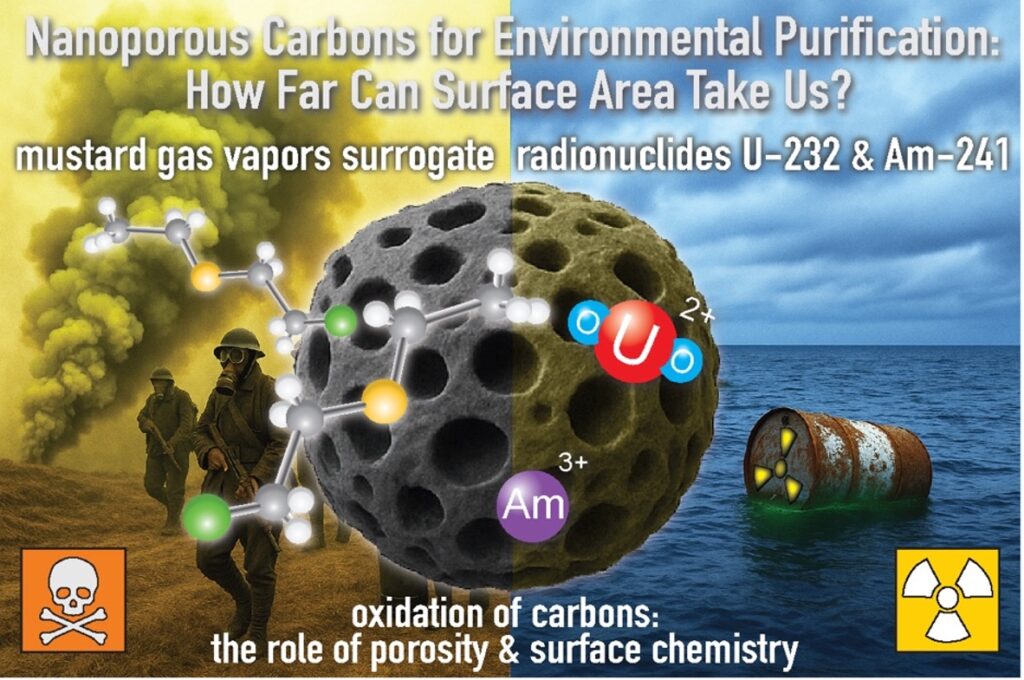
ABSTRACT: Nanoporous carbons are widely employed in environmental remediation applications due to their high surface area, tunable porosity, and adaptable surface chemistry. In this study, three commercial activated carbons, MSC, CPL, and SXP, were intentionally and precisely selected to span a broad range of surface areas (~1000–3000 m²/g) and surface pH values (5.3–7.5), enabling a comparative evaluation of their physicochemical properties and adsorptive performance. These materials and their oxidized counterparts were tested against hazardous vapors (blister agent mustard gas surrogate, CEES) and aqueous pollutants (radionuclides U-232 and Am-241). MSC exhibited an ultrahigh surface area and delivered the highest CEES uptake (1397 mg/g), the highest reported to date. However, oxidation significantly decreased porosity, resulting in diminished vapor-phase performance. In contrast, the same oxidation enriched the surfaces with acidic oxygen-containing functional groups, substantially enhancing radionuclide affinity, especially in neutral and saline media. The oxidized MSC outperformed all other materials in aqueous radionuclide removal, across a wide range of pH (4-9) and more importantly, in seawater. These results reveal the dual role of oxidation: beneficial for liquid-phase adsorption through surface complexation, yet unfavorable for gas-phase purification where pores volume and accessibility maters the most. Overall, this work underscores the importance of tuning both surface area and surface chemistry for application-specific purification strategies and finally that activated nanoporous carbons can push even further the boundaries for efficient air and aqueous purification applications.
Peer-Reviewed Article #2
Are commercial filtration media efficient under realistic environmental conditions? The uprise of Nanoporous Activated Carbon Textiles with antibacterial efficiency for air and water purification
Fivos Florides1, Marlena Bytniewska1, Anna Michalicha2, Mariusz Barczak1, Dimitrios A. Giannakoudakis1*
1 Faculty of Chemistry, Maria Curie-Sklodowska University, 20031 Lublin, Poland
2 Chair and Department of Biochemistry and Biotechnology, Medical University of Lublin, Chodźki 1, 20-093 Lublin, Poland
submitted
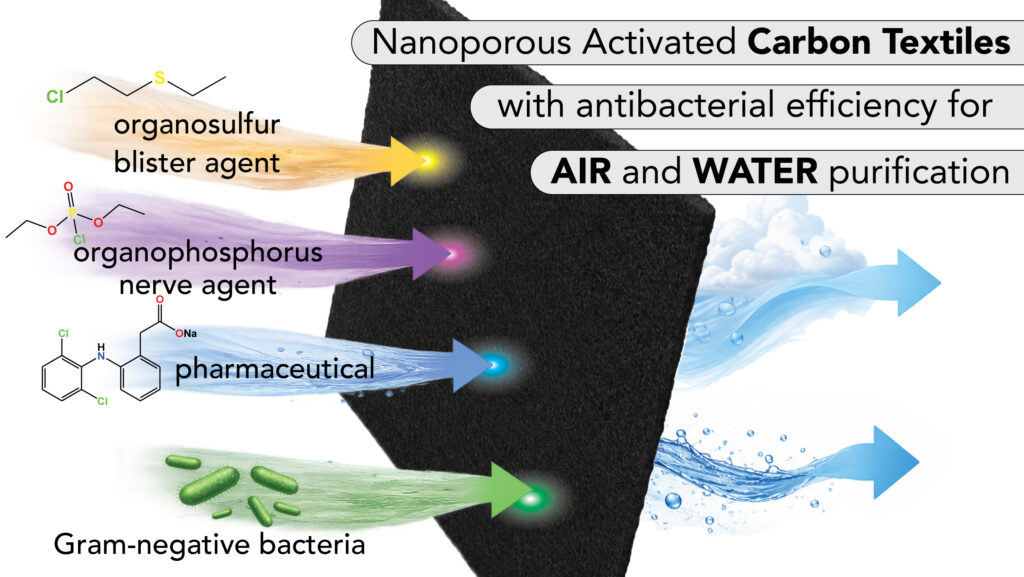
ABSTRACT: The growing risk of chemical hazards, combined with persistent water and air pollution, highlights the urgent demand for affordable multifunctional filtration materials capable of operating under realistic environmental conditions. Herein, commercially available nanoporous activated carbon textiles (C-Texts) with different architectures were evaluated as multifunctional protection media against chemical warfare agent (CWA) simulants and aqueous pollutants. Their performance was benchmarked against commercial single-use face masks (Co-Masks) and air-filtration foams (SPNGs) using 2-chloroethyl ethyl sulfide (CEES) and dimethyl chlorophosphate (DMCP) as simulants of organosulfur blister mustard gas (HD) and organophosphorus nerve agents, respectively. The nanoporous carbon textiles exhibited substantially higher vapor uptake and stronger retention than the Co-Masks and SPNGs owing to their highly developed microporosity and tunable surface chemistry. Selected textiles (FM30K and FM10W) were oxidized using a concentrated sulfuric/nitric acid treatment. Surface oxidation altered porosity and surface chemistry, increasing acidity and introducing oxygen- and nitrogen-containing functionalities that promoted catalytic CEES transformation toward less harmful products, mainly ethyl vinyl sulfide (EVS), while also affecting adsorption under humid conditions. Although humidity slightly influenced vapor uptake, catalytic detoxification pathways remained active. The selected textiles and their oxidized counterparts were additionally evaluated for diclofenac removal, revealing textile-dependent behavior, since oxidation enhanced the adsorption performance of the woven textile while negatively affecting the knitted counterpart. In addition, antibacterial activity against Gram-negative bacteria was improved after oxidation treatment. Overall, this work demonstrates that nanoporous activated carbon textiles can serve as scalable multifunctional platforms for simultaneous chemical protection and environmental remediation.