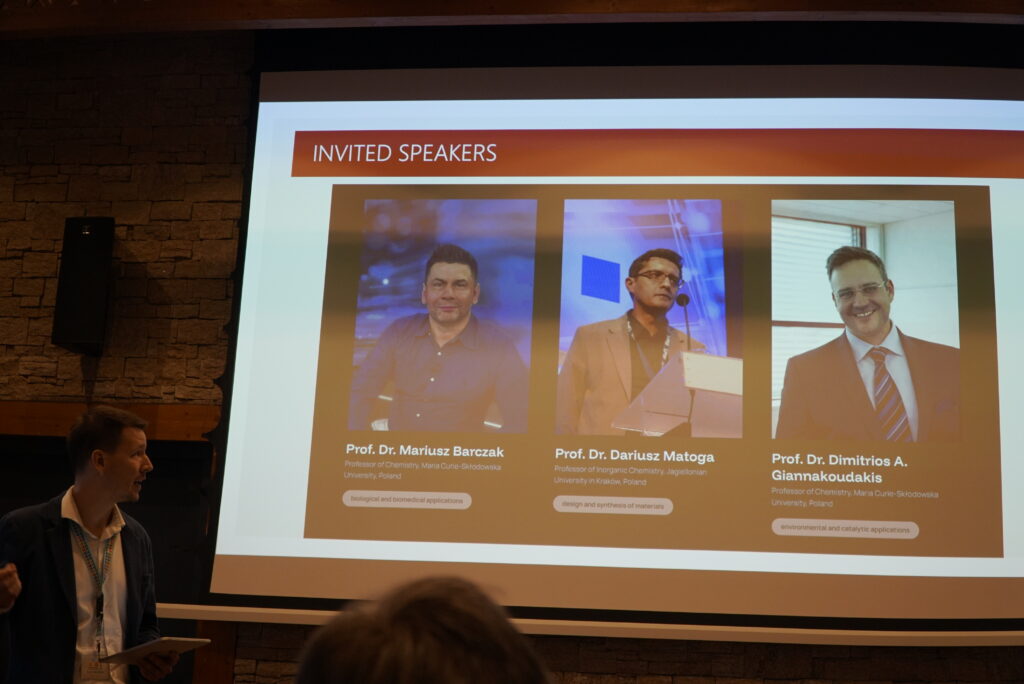
INVITED SPEAKER
Bimetallic MOF Composites Decorated on Porous Carbon Textile for Multifunctional Air and Water Purificationvia Catalysis–Adsorption Synergy
Fivos Floridesa, Kyriacos Ioannoua,b, Marlena Bytniewskaa, Nikolaos Kostoglouc, Anna Michalichad, Claus Rebholzb, Mariusz Barczaka, Dimitrios A. Giannakoudakisa*
a Institute of Chemical Sciences, Faculty of Chemistry, Maria Curie-Sklodowska University, 20-031 Lublin, Poland
b Department of Mechanical and Manufacturing Engineering, University of Cyprus, 2109 Nicosia, Cyprus
c Institute of Geoenergy, Foundation for Research and Technology – Hellas, 73100, Chania, Greece
d Chair and Department of Biochemistry and Biotechnology, Medical University of Lublin, Chodźki 1, 20-093 Lublin, Poland
ABSTRACT: The development of next-generation materials for air and water purification, ranging from household filtration systems to personal protective equipment for emergency or crisis situations, such as gas masks and garments, requires multifunctional remediation media capable of capturing, degrading, and neutralizing diverse hazardous species. In this context, the synthesis of reactive nanomaterials plays a key role [1].
Metal-Organic Frameworks (MOFs) possess unique physicochemical characteristics, including high and hierarchical porosity, accessible reactive centers within their pores/cages, and the ability to exist as nanostructured particles. However, their practical deployment is limited by several drawbacks, such as insufficient thermal and chemical stability, particularly poor resistance to humidity, high cost, and challenges associated with large-scale synthesis. To overcome these limitations, it is essential to design MOF-based materials/composites that mitigate these inherent weaknesses [2-4]. In this work, two main strategies are followed: (i) the development of defect-rich bimetallic frameworks and (ii) the formation of composites with carbon-based nanostructures, including reduced graphene oxide, graphitic carbon nitride, and carbon quantum dots. Toward real-life applications, our goal is to employ the greenest possible synthesis protocols, achieving high yields using water as the sole solvent and mechanochemical driven approaches, while minimizing the required amount of MOF material by homogeneously decorating selected substrates [2,5].
Within this content, we demonstrate the optimization of the synthesis of bimetallic MOFs, specifically Zeolitic Imidazolate Frameworks (ZIFs) based on Co- and Zn (ZIF-678), using water as the only solvent (Figure 1). Systematic variation of the metal ratios enabled compositional optimization to maximize porosity, structural stability, and active-site availability. Subsequently, we examine how composite formation using minimal carbon-based filler loadings (~1 wt.%) effectively enhances key physicochemical properties and, consequently, the remediation efficiency of ZIF-678 toward organic contaminants in both water and air. Pharmaceuticals were employed as model water contaminants, while chemical warfare agent (CWA) vapors, including blister and nerve agents, served as representative airborne threats. In addition, the chemical and hydrothermal stability, H2 storage and CO2 capture capacity, as well as antibacterial activity of the ZIF-678 composites were evaluated. The bimetallic ZIF-678 nanocomposites exhibited significantly enhanced porosity, gas-storage performance, and antibacterial efficiency compared to their monometallic counterparts.
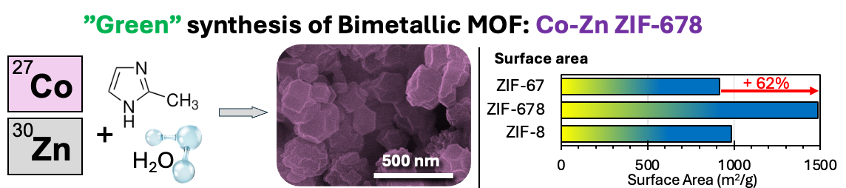
Figure 1. Schematic illustration of the green, water-based synthesis of defect-rich bimetallic Co–Zn ZIF-678 nanocrystals. A relative enhancement in textural properties of up to +62% is observed for the bimetallic ZIF-678 compared to monometallic analogues.
Nanoporous carbon textiles (C-Texts) are highly attractive candidates, either as standalone materials or as substrates, for air and water purification applications due to their high surface area, tunable surface chemistry, low density, flexibility, and cost-effectiveness [6-8]. Nevertheless, their rational optimization remains challenging and relies on two complementary strategies: (i) fine-tuning key physicochemical properties, particularly surface-chemistry heterogeneity, and (ii) nanoengineering through the incorporation of catalytically active nanophases [6-2,8]. Based on our experience, it was determined that, for C-Texts to be effectively utilized as substrates, surface-chemistry heterogeneity must be enhanced, especially through the introduction of oxygen-containing functional groups [2]. In addition, we demonstrated that the detoxification efficiency of C-Texts is not affected by the presence of humidity, which may originate from environmental conditions or from perspiration and breathing during use [9].
Building on these materials-design principles, this work highlights also strategies to enhance the multifunctional performance of C-Texts for air and water decontamination toward large-scale protective media. Initially, the adsorption efficiency of commercial and chemically modified C-Texts was evaluated, identifying the physicochemical parameters most critical to performance, while systematically investigating the influence of humidity under realistic conditions. Further improvements were achieved by developing scalable and cost-effective methods to decorate C-Texts with minimal loadings of mono- and bimetallic MOFs, specifically ZIF-based active phases. The resulting hybrid textiles (Figure 2) exhibited superior removal of diclofenac from water, as well as catalytic detoxification of CWA vapors and droplets, accompanied by exceptionally high antibacterial efficiency. These enhancements are attributed to homogeneous nanoparticle dispersion and synergistic adsorption–catalysis interfacial effects, with oxygen-containing surface functional groups on the C-Texts playing a key role by enabling efficient catalytic detoxification, strong and stable retention of hazardous molecules, and successful crystallization and anchoring of the ZIF nanoparticles.
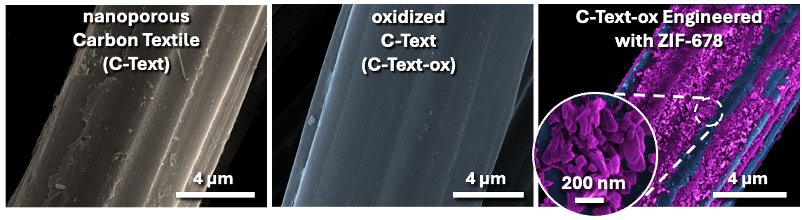
Figure 2. Scanning electron microscopy (SEM) images illustrating the surface morphology evolution of nanoporous carbon textiles (C-Texts): pristine C-Text on the left, oxidized C-Text (C-Text-ox) at the center, and C-Text-ox homogeneously engineered with Co–Zn ZIF-678 nanoparticles on the right. Oxidation induces surface cleaning/roughening and enhanced surface chemical heterogeneity, enabling uniform anchoring of ZIF-678 nanocrystals, as highlighted in the magnified inset.
Acknowledgements
The work is financially supported by the National Science Centre (NCN) of Poland via the SONATA-19 grant 2023/51/D/ST5/01915 (PI: D. Giannakoudakis).
References
[1] D. A. Giannakoudakis, T. J. Bandosz, Detoxification of Chemical Warfare Agents: From WWI to Multifunctional Nanocomposite Approaches, Vol. 1, Springer International Publishing, 2017.
[2] D. A. Giannakoudakis, P. S. Pauletto, M. Florent, T. J. Bandosz, RSC Adv. Interfaces, 2 (2025) 1275-1287
[3] D. A. Giannakoudakis, T.J. Bandosz, Molecules, 24 (2019), 4529,
[4] D. A. Giannakoudakis, T.J. Bandosz, ACS Applied Materials and Interfaces, 12 (2020) 14678-14689
[5] D. A. Giannakoudakis, Y. Hu, M. Florent, T. J. Bandosz, Nanoscale Horizons, 2 (2017) 356-364
[6] D. A. Giannakoudakis, M. Barczak, M. Florent, T. J. Bandosz, Chemical Engineering Journal, 362 (2019) 758-766
[7] D. A. Giannakoudakis et al., Chemical Engineering Journal, 524 (2025) 169457
[8] P. S. Pauletto, D. A. Giannakoudakis, M. Florent, T. J. Bandosz, Carbon, 230 (2024) 119673.
[9] D. A. Giannakoudakis, P. S. Pauletto, M. Florent, T. J. Bandosz, Journal of Hazardous Mat., 487 (2025) 137155